DD Bread - {Diverse & Digestible}
An exciting journey has begun.

Thanks for reading Şemsa’s food per se! To receive new posts and support my work, consider becoming a free or a paid subscriber.
Subscribe for free to get notifications for my words, published randomly. They remain reachable for a full month before going behind the paywall. After that to reach my archive of posts, you may prefer to go paid.
The monthly fee is €8, I would suggest choose the yearly option of only €48. That would make the month €4, a price I consider most reasonable.
If your reason to go paid is to show your heartfelt support for me writing, then please know it’s much appreciated.
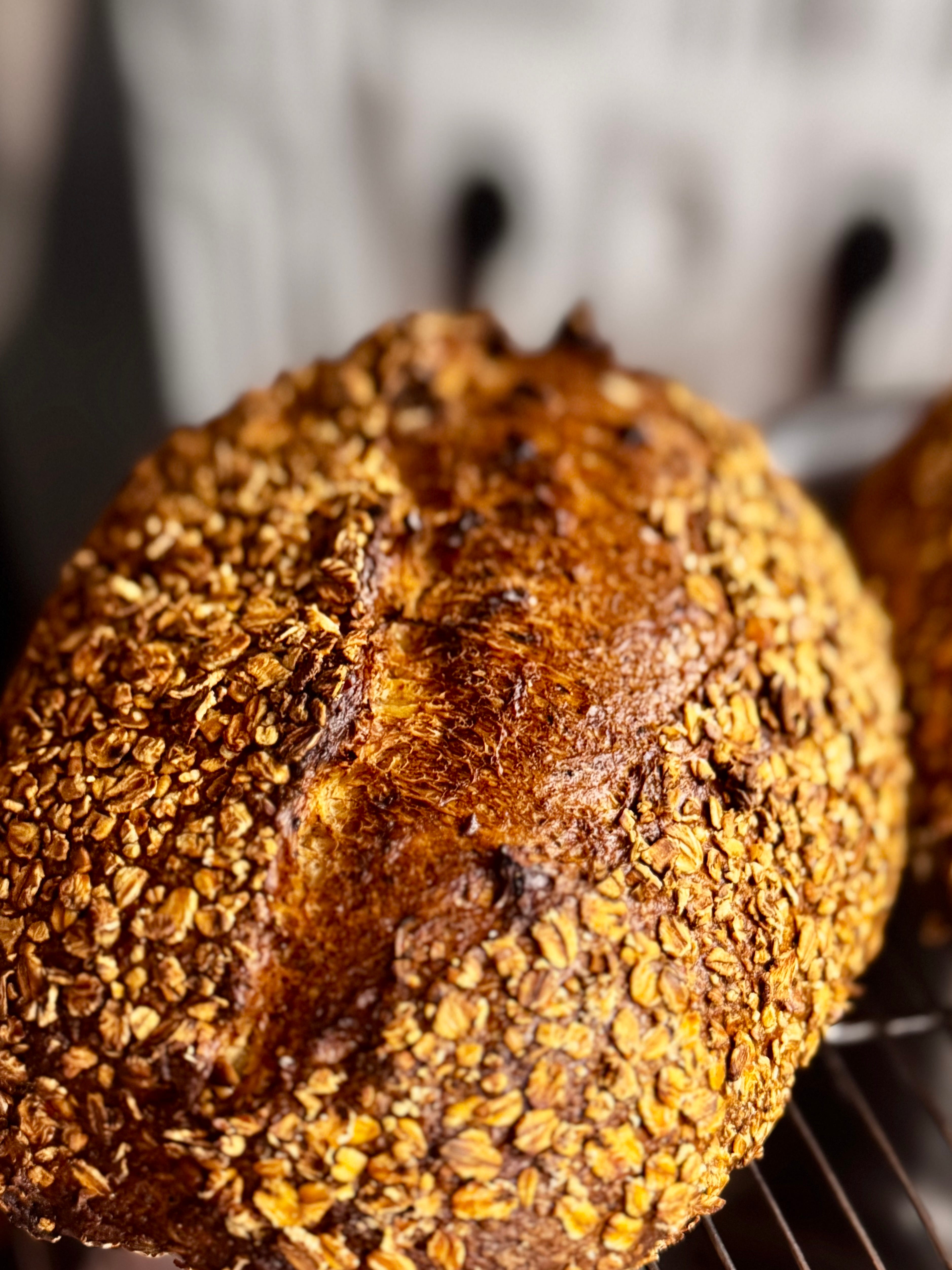
A new kind of bread.
At least new for me. The idea of incorporating more whole flours and seeds and other cereals has been going on in strength for some years now, but I have only caught up with it recently. I was not considering bread as part of a nutrition point of view but rather a food substance I have enjoyed mastering and eating and sharing. And how obsessed I became with it!
I have been reading about nutrition more, from a health point of view, trying to maybe understand it better. Yes, I was already very conscious about what I ate. It was always seasonal, locally grown, organic as much as possible. Also after a life change of having a gastric sleeve operation 14 years ago, I tried to steer away from eating anything that would disturb me in the aftermath. Not that I always succeeded.. But mostly I stayed away from pasta, pastry, heavy starches and sweets. The only exception was bread. My sourdough bread.
In the first years after the operation, I couldn’t digest anything with wheat, be it pasta or borek or bread. As time passed, my stomach got also larger and adapted to its’ new existence, I could afford to eat all the said stuff occasionally. I still don’t prefer to dive into the pasta/börek I love so much, as they still upset my stomach. And I don’t eat bread that’s not worthy. Meaning unless it is sourdough, properly fermented, made with organic stoneground flours and done with all the care, it does not cut into my ‘worthy’ standard.
As I am obsessed with baking my sourdough bread, I cannot forego consuming it. I can’t have too much and too fresh, always toasted so it will not clump into a sticky mass in my stomach making digestion impossible. The way my doctor described it to me years ago after the operation always stuck with me: “Imagine having a piece of stale bread which you wet with your saliva and make it into ball which you then put on a fishing hook to catch fish… it doesn’t get torn apart even in water; that is bread/pasta in your stomach”
Very clear, isn’t it?
So, if I am going to eat it, it better needs to be “worthy”
This idea of making bread part of your nutrition, is relatively recent for me. To make a proper nutrition-worthy bread is my aim. It is a journey I have started recently and at this point I have managed to make a bread of diversity and digestibility I enjoy eating. I used a wonderfully diverse selection of flours: %35 high extraction flour, %20 wholewheat, %20 whole rye, %10 each of durum wheat and Einkorn, %5 barley, all organic and stone ground. To enhance the diversity I have added the cereals of oat and buckwheat in the form of porridge and also tarhana which is already a fermented mix of grains and yoghurt that is used for making soup in Anatolia. And added seeds -sesame, pumpkin and sunflower- and walnuts. The salt is an artisanal hand-harvested Aegean sea salt, and lastly an extra virgin cold pressed olive oil high in polyphenols.
All of this made into a dough with sourdough starter, long retarded bulk fermentation of 29 hours and final cold proof of 12 hours. This over 40 hours fermentation is very important in changing the chemical composition of the gluten to make it easily digestible.
Hence DD bread. Diverse & Digestible.


As I said this is only a beginning. Now I can build upon this understanding and learn on the way. Will be going deep into sprouted grains, more whole-flours, herbs and spices, more nuts and seeds, maybe even longer fermentation… we shall see. A most exciting journey indeed.
DD bread {Diverse & Digestible} v.01
Baker’s percentages & Method
%100 Flour [%35 high extraction flour, %20 wholewheat, %20 whole rye, %10 durum wheat, %10 Einkorn, %5 barley, all organic and all stone ground]
%70 Water
Mix, make sure no dry flour remains, cover and let autolyse for an hour.
%15 Levain [%40 stiff starter + %110 water + %100 strong bread flour; used young in 3-4 hours]
%15 Liquid [%5-6 Egg + %9-11 Water; weigh your egg first and add the water as remaining balance to make it to a total of %15]
Add your levain and liquid and mix till everything is incorporated by squeezing and folding and kneading.
Set aside for 30 minutes, covered at room temp.
Go on mixing and soaking the following:
%20 Oat porridge [1 part oat flakes + 2 parts lukewarm water]
%5 Buckwheat porridge [1 part buckwheat flakes + 2 parts lukewarm water]
%15 Soaked tarhana [1 part tarhana + 1 parts lukewarm water]
Cook both oat and buckwheat flakes with water in the same pot over medium heat till creamy and stiff-ish. Set aside to cool.
Soak tarhana in a bowl and also set aside.
Add all the cooked and cooled porridges along with the soaked and uncooked tarhana into your dough. At this point none of them would be too wet, no excess water. If there is omit that.
Again mix till everything is incorporated by squeezing and folding and kneading.
Set aside for 20-30 minutes, covered at room temp.
%3 Salt
%9 Water [can be more or less depending on your flours; whatever the amount add it in small increments -bassinage- also keep in mind you will be adding olive oil at the end, which also creates more wetness.]
%3 Extra virgin olive oil [pour in gradually, make sure it absorbs first before adding the rest]
After all is in and throughly mixed, start your folds. Depending how wet is your final dough, space them in 15 - 30 minutes intervals. The wetter the more frequent; less wet means farther apart intervals.
Always start first 2-3 times with stretch and folds.
At the fourth, if you feel your dough is ready for coil fold, add
%25 Seeds and nuts [roasted and cooled down]
Now space the folding 30-45 minutes apart and do 2 more coil folds. If necessary even more.
After the last coil fold -mine was 6th- transfer to a lightly oiled container and keep one more hour at room temperature before shoving it into the fridge +8C for 16-24 hours.
Afterwards shape either as a boule or batard to your liking and put back to the fridge for another 9-14 hours at +8C.
Preheat your oven at your highest setting either with a baking steel or a Dutch oven. Bake directly from fridge your usual way.
Hello Semsa. This bread certainly is diverse and digestible from a nutrition standpoint. I love that you have so much variety in there to provide fibre for your microbiome to keep you immune system well and help digest food. You asked me how one could make this even more diverse and digistible. The other ingredient I would find really interesting to see combined with sourdough grains, would be the addition of a little flour made from chickpeas or lentils. These "legume" flours provide special "prebiotic" fibre which helps feed the microbiome into a healthy pattern (good for digestion, and helps slow down digestion so we feel fuller for longer). The other thing that really interests me recently about sourdough is the following. Yes the dough contains lots of probiotic lactic acid bacteria which help break down the elasticky gluten ahead of eating it, so much easier on the tummy. But what excites me is the new research which focuses on the postbiotics. When the probiotics go in the oven, they are killed off by the high temperature. But what they leave behinds are these postbiotics also known as metabolites such as short chain fatty acides like butyrate. This helps mend the gut lining and keep inflammation low in the body. Butyrate can even travel up to the brain and help us think sharper. Conclusions: sourdough is fabulous and an important part of a gut healthy diet - which influences the rest of our health too.