Lahmacun!
When you suddenly crave something deeply, the task inevitably lands on your own shoulders.

Please subscribe for free to get notifications for my words, published randomly. They remain reachable for a full month before going behind the paywall. After that to reach my archive of posts, you may prefer to go paid.
The monthly fee is €8, I would suggest choose the yearly option of only €48. That would make the month €4, a price I consider most reasonable.
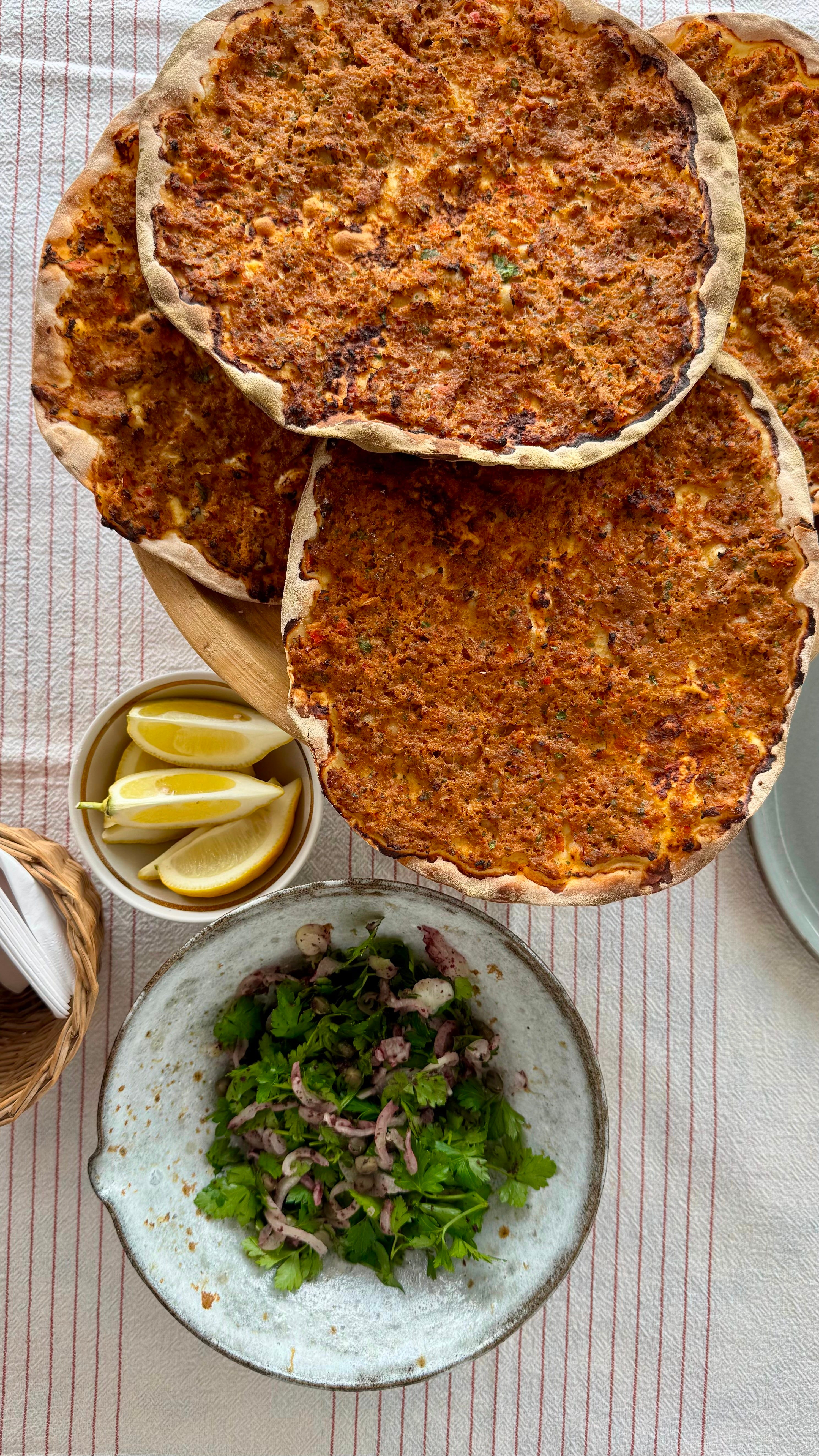
I really, really craved lahmacun. Really.
Even if there is good lahmacun in Thessaloniki, I doubt it would be that good, so I decided I had no choice but to make it myself. Quite ambitious, honestly. I certainly know how to eat lahmacun, but I had never dared to make it before, nor had I ever felt the need. But that is one of the very occasional things about living abroad: when you suddenly crave something deeply, the task inevitably lands on your own shoulders.
Over the last year, I have admittedly improved quite a bit when it comes to doughs and rolling them out. The yufka issue, as some of you may remember from earlier posts, was resolved by learning how to roll it out by hand. Encouraged by the progress I made there, I ventured into lahmacun territory.
The first question, naturally, was: what about the dough?
After a bit of internet research and an Instagram rabbit hole, I came across a recipe by Betül Tunç of Turkuaz Kitchen. I liked the logic of it, so I used it as my starting point.
As for the topping, everywhere seemed to call for tomato paste or tomatoes. However, I learned that Sinem Özler at Seraf never uses either tomatoes or tomato paste. As I admire both Sinem’s palate and her meticulous research immensely, I decided to try without the addition of any tomatoes instead.
I cannot remember if I mentioned this before, but when I made su böreği, the generous measurements and instructions Sinem shared had guided me beautifully, and the result was spectacular. So once again: a thousand thanks. When you do not know something, you ask the person who does.
Back to lahmacun.
Dough
250 g AP flour — 100%
140 g water — 56%
10 g olive oil — 4%
5 g salt — 2%
Mix all the ingredients together and let the dough rest for 15–20 minutes.
Then knead on a lightly floured surface until completely smooth.
Cover and let it rest again for 30–60 minutes.
Divide into portions depending on the size you want — mine were 50 g each — and roll them tightly against the counter with your palm until you have elastic little dough balls.
Cover again and let them rest, ideally for an hour. I had errands to run, so mine sat for over two hours, and it caused no problems whatsoever. On the contrary, I think the dough rolled out even better.
Meanwhile, prepare the topping.
Topping
200 g ground lamb (hand-chopped would be ideal)
1 small onion
½ red pepper
½ green pepper
1 garlic clove
1 handful parsley
Salt & black pepper
Pul biber / Aleppo pepper
Lukewarm water
Olive oil
Finely chop the onion, garlic, and peppers together until the vegetables release their juices. Salting also helps here. Or, if you do not trust your knife skills, pulse everything in a machine.
Mix with the lamb and spices.
Add a little olive oil and a bit of water to create a very loose, almost runny topping mixture.
All of this can be prepared ahead of time.
When you are ready to bake the lahmacun, I strongly recommend heating either a pizza stone or a cast-iron baking steel in a 250°C oven for a full hour beforehand. I have two steels, and since I wanted to bake four lahmacun at a time, I portioned the dough into 50 g balls. Adjust according to your own setup, of course.
That said, this topping was still not exactly what I wanted. The dough — its crispness, flavour, texture — was absolutely there. But the topping still needs work, in my opinion.
Once the oven, stone, or steel is thoroughly heated, lower the temperature to 240°C and start rolling out the doughs.
Roll them out with flour and shake off any excess.
Spread the loose lamb mixture over the top, leaving only a very thin border around the edges — just picture lahmacun in your mind.
Bake immediately.
In my oven, they took about 7–8 minutes.
Once out of the oven, transfer them onto a wire rack so they do not steam and soften.
Serve while still hot with parsley salad, onions, tomatoes, and plenty of lemon.
This recipe made eight dough balls. We thought we would each politely eat two lahmacun and be done with it. Instead, we had clearly missed them far too much and demolished three each without hesitation. I tucked the remaining two dough balls into the fridge, but never got around to making them — we hit the road.
On our last morning before leaving, we cracked eggs into the leftover topping mixture and cooked it in a pan for breakfast. It worked beautifully with eggs, though for lahmacun it still was not quite the there it is! consistency I am after.
But I will not let it defeat me. I will keep making it again and again until I get exactly the result I want.
The important thing was mastering the dough. That part is done.
And once I arrive at the version that truly satisfies me, I promise I will write about it again.
What a joy it was to find this recipe, and then a reference to su böreği too. I will go read that next!! I only lived in Istanbul for two years but I believe the food, from your side of the world, was the best of any place I lived. I never reached Thessaloniki, I need to spend some time reading more of your writing now.
🧿🧿❤️❤️🥰